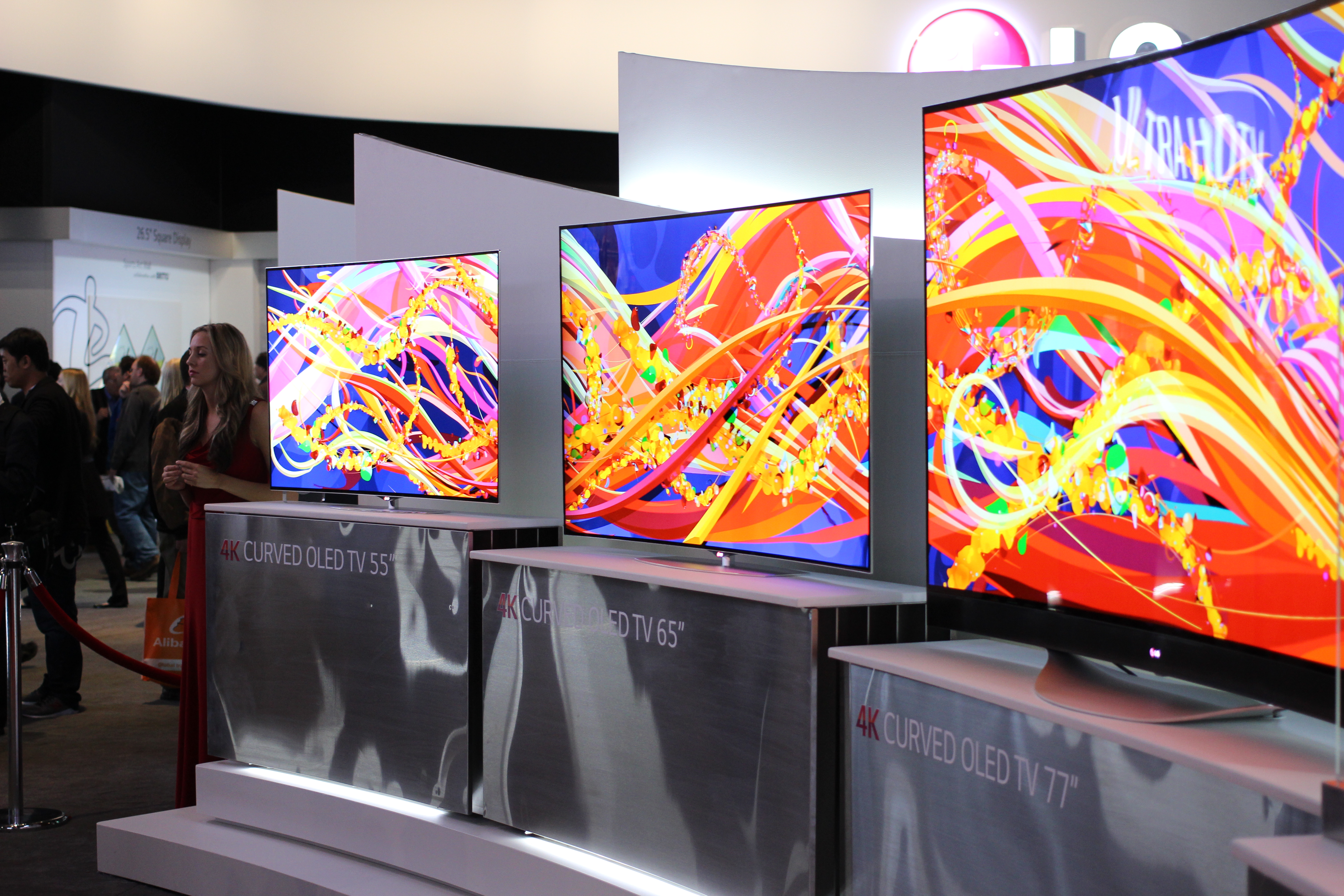
For two decades, the top shelf of the American TV market has been a two-company argument, and both companies happen to be South Korean. Samsung has finished first in global TV shipments for roughly twenty straight years. LG has owned the OLED crown for thirteen. Walk into any Best Buy and the two best pictures on the wall almost always carry one of those two logos, priced within a few dollars of each other and daring you to spot the difference.
For most of that run, the choice came with a tidy rule of thumb: LG made the OLEDs with the perfect inky blacks, Samsung made the blinding-bright QLEDs for sun-soaked rooms, and you picked based on your curtains. That rule fell apart in 2026. Samsung now sells quantum-dot OLEDs brighter than anything LG has ever shipped. LG's flagship panel got so much brighter it stopped losing the bright-room argument. And in a twist nobody would have predicted three years ago, Samsung just outsold LG in OLED TVs in North America for the first time.
So the honest answer, before we get into it, is that neither brand simply "wins" in 2026. The right call turns on three things the showroom won't explain: how much light hits your screen, which HDR format your movies are mastered in, and how far your budget stretches. Sort those out and the decision makes itself.
The Panel Gap Isn't What It Used to Be
The two brands still build their OLEDs differently, and the difference matters less every year. LG's 2026 flagship, the OLED evo G6, uses its Primary RGB Tandem 2.0 panel — a stacked "four-layer" white-OLED design driven by the new Alpha 11 AI Processor Gen3. LG claims its Brightness Booster Ultra system, marketed this year as Hyper Radiant tech, pushes the G6 to as much as 3.9 times the brightness of a standard OLED, with "Perfect Black" and "Perfect Color" ratings verified by UL Solutions. In plain terms, the G6 runs about 45% brighter than last year's G5.
Samsung takes the quantum-dot route. Its flagship S95H is a QD-OLED, layering quantum dots over a blue OLED source to squeeze out more saturated color at high brightness. According to the full-lineup breakdown by Forbes' John Archer, the S95H hits nearly 4,500 nits on small 1–2% test windows and more than 2,700 nits on a 10% window, covering 100% of the DCI-P3 color space. It's roughly 35% brighter than 2025's S95F and wraps the panel in Samsung's new FloatLayer design for a near flush-to-wall look. Samsung's step-up S99H adds a metal bezel and sits at the very top of the range.
In a dark home theater, the practical gap between these two is small — both render shadow detail and true black that mid-range LCDs can only fake. In a bright room, Samsung's combination of higher peak nits and its matte anti-reflection coating still pulls ahead, and notably that Glare Free screen now trickles down to the cheaper S90H too.
What You'll Actually Pay in 2026
Here's where LG scored an easy point: it barely raised prices. The 2026 flagships launched at essentially the same numbers as 2025, which is rare in a market where "new model" usually means "new premium." Samsung's OLEDs land in the same neighborhood, and its mini-LED sets undercut everything LG offers.
| Feature | LG OLED evo G6 | Samsung S95H |
|---|---|---|
| Panel | Primary RGB Tandem 2.0 (WRGB) | QD-OLED (quantum dot) |
| 55-inch launch price | $2,499 | $2,499.99 |
| 83-inch price | $6,499 | ~$6,299 |
| Peak brightness | Up to 3.9x a standard OLED | ~4,500 nits (1–2% window) |
| HDR formats | Dolby Vision, HDR10 | HDR10+, HDR10+ Advanced |
| Smart platform | webOS 26 | Tizen |
| Panel warranty | 5-year limited | Standard |
Below the flagships, both ranges run deep. LG's mainstream OLED evo C6 starts at $1,399 for the 42-inch and climbs to $5,299 for the 83-inch, and LG quietly slipped the flagship Primary RGB Tandem 2.0 panel into the 77- and 83-inch C6 models it now calls "C6H." (There's also a genuinely absurd 97-inch G6 at $24,999, in case your living room is a movie theater.) The full pricing sheet is in LG's own announcement, with retail availability that began in March 2026.
Samsung answers with the WRGB-panel S90H ($1,399.99 to $5,299.99), which this year adds both the Glare Free coating and 165Hz gaming, plus an even cheaper entry OLED, the S85H, starting at $1,199.99 for a new 48-inch size. And if OLED prices make you flinch, Samsung's M80H mini-LED line runs from $699.99 to $1,799.99 — a bright-room-friendly option with no real LG OLED equivalent at that price.
The Format Cold War Nobody Mentions in the Store
This is the single most overlooked factor in the entire Samsung-versus-LG decision, and it has nothing to do with the panel. It's about which high-dynamic-range formats each brand will play.
Samsung has never supported Dolby Vision, the dynamic-metadata HDR format used by Netflix, Disney+, Apple TV+, Max, and the overwhelming majority of 4K Blu-rays. Instead Samsung backs the royalty-free HDR10+ standard it co-created, and in 2026 it rolled out HDR10+ Advanced as its answer to Dolby Vision 2. LG is the mirror image: its sets play Dolby Vision and HDR10, but not HDR10+. And in a rare stumble, LG's 2026 lineup skips the new Dolby Vision 2 entirely.
What that means in your living room is simple. Feed a Samsung a Dolby Vision movie and it falls back to plain HDR10 — you still get a great picture, just without the scene-by-scene tone mapping. Feed an LG the same title and it uses the full Dolby Vision track. Since most premium streaming and disc content is mastered in Dolby Vision, the movie-first buyer with a big Blu-ray shelf leans LG. If your household lives on Amazon Prime Video, which favors HDR10+, Samsung has the matching format. Either way, the store associate almost never brings this up.
Gaming Is Basically a Dead Heat
A few years ago LG ran away with the gaming crown. In 2026 it's close enough that most players won't feel a difference. Both brands' 2026 OLEDs now hit 4K at 165Hz with variable refresh rate — LG across the C6 and G6, and Samsung on the S90H, which Forbes notes is "165Hz gaming support for the first time at this level." Samsung's Neo QLED sets top out at 144Hz; its entry S85H OLED runs 4K/120Hz. LG's panels also carry VESA's ClearMR 10000 motion certification.
"It's never been a closer contest," TechRadar wrote after testing Samsung's best OLED against the LG G6 side by side in 2026.
The tiebreakers are narrow. LG has historically fitted four full HDMI 2.1 ports and, crucially for console players, supports Dolby Vision gaming — a real advantage if you game on an Xbox Series X with Dolby Vision titles. Samsung counters with FreeSync Premium Pro, effectively instant response times, and that anti-glare panel that keeps a lit game room from washing out the picture. Console-and-cinema gamers lean LG; bright-room and high-nit HDR gamers lean Samsung.
Living With Tizen and webOS
You'll spend more time staring at the home screen than reading spec sheets, so the software counts. Samsung runs Tizen; LG runs the 2026 build of webOS. Both are mature, both stack a lot of app tiles and sponsored content on the home page, and both bundle a wall of free ad-supported channels — Samsung TV Plus versus LG Channels — that are genuinely handy for background viewing.
The feel is where they diverge. LG's Magic Remote still uses its point-and-wave cursor, which newcomers either love or fight for a week before loving. Samsung's slimmer solar-powered remote skips the cursor and leans on a cleaner button layout. Neither platform is meaningfully "smarter" than the other in 2026, and if the built-in software ever annoys you, a $40 streaming stick erases the difference. Treat the OS as a tiebreaker, not a dealbreaker.
Who's Actually Winning the Sales Floor
The scoreboard tells a more interesting story than the spec sheets. Samsung remains the world's number-one TV brand overall, holding around 16–17% of the global market and finishing first for roughly twenty consecutive years, with LG in a steady second place near 15%.
But zoom into OLED specifically and LG still rules. It led the global OLED TV category with close to half of all units shipped in 2025 — roughly 3.22 million of the 6.47 million OLED sets sold worldwide — and from mid-2025 to mid-2026 it led the popular 65-inch premium segment with a 44.0% share to Samsung's 39.5%. Analysts at Omdia expect OLED shipments to plateau around 6.9 million units a year through 2030, so these two are fighting over a prize that isn't growing much.
The headline shift is regional. As FlatpanelsHD reported, Samsung overtook LG in North American OLED TV sales in a single quarter for the first time — only three years after re-entering the OLED business in 2022. LG invented the modern OLED TV; Samsung is now beating it at that game on American soil.
So Which One Deserves Your Money?
Buy the LG if your setup is a darker room, your library leans on Dolby Vision streaming and 4K discs, or you're a console gamer who wants Dolby Vision play and a five-year panel warranty. The C6 is the sweet-spot value, and the 77- or 83-inch C6H hands you flagship-grade brightness for less than the G6.
Buy the Samsung if your screen fights daylight and glare, you watch a lot of sports, or you want OLED brightness with the best anti-reflection coating on the market — the S95H for the flagship experience, the S90H for the same Glare Free tech at a friendlier price. And if OLED simply costs too much, only Samsung offers a strong mini-LED fallback like the M80H under a thousand dollars.
The uncomfortable truth for brand loyalists is that in 2026 the badge matters less than the room it hangs in. Match the TV to your light, your content, and your budget, and both Samsung and LG will hand you a picture that would have cost twice as much and looked half as good five years ago.